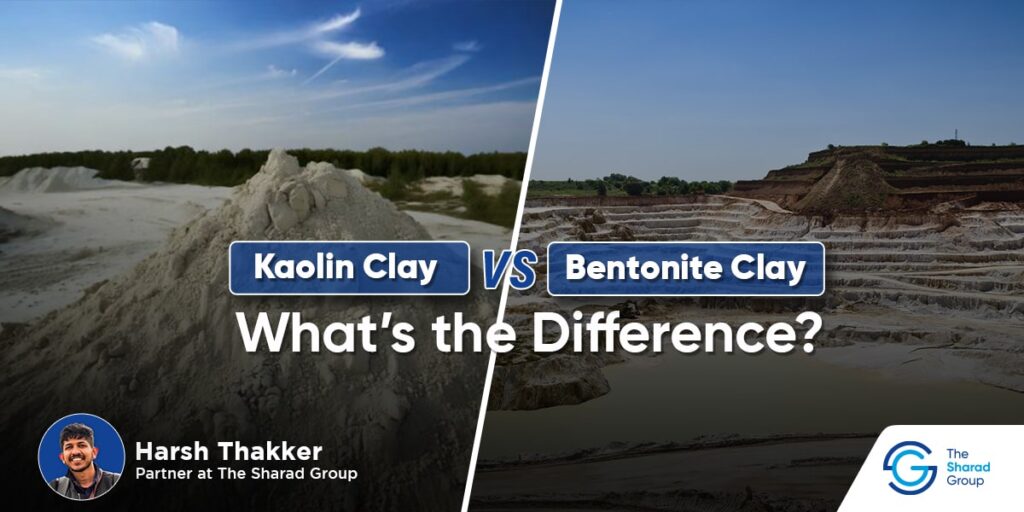
If you want to know the difference between kaolin and bentonite clay, I’m glad you are here!
If you do a side-by-side comparison of them, they might appear very similar: they’re both powdery, and they’re both fine.
But that’s where the similarities stop, and the differences begin!
In fact, as we will see, some of their chemical and physical properties are so different from each other that you might even find it hard to believe that they both belong to the same family of materials!
In this blog, I am going to break down all the major differences between kaolin clay vs bentonite clay.
Let us get started!
Kaolin Clay vs Bentonite Clay: Table of Contents
- Quick Table of Comparison: Kaolin Clay vs. Bentonite Clay
- What is Kaolin Clay?
- What is Bentonite Clay?
- The Difference Between Kaolin Clay and Bentonite Clay
- The Sharad Group: Your Reliable Kaolin and Bentonite Clay Provider
- Kaolin Clay vs. Bentonite Clay: FAQs
Quick Table of Comparison: Kaolin Clay vs Bentonite Clay
In a hurry to find the right clay for your product?
I have you covered! Just scan this table of differences between kaolin and bentonite clay!
| Point of Difference | Kaolin Clay (China Clay) | Bentonite Clay |
| Formation | Chemical weathering of feldspar | Alteration of volcanic ash |
| Key Feature | White, inert, smooth | Swelling, binding, gelling |
| Appearance | Bright white, cream, yellow | Grey, cream, green, yellow |
| Swelling Property | Non-swelling | High swelling (expands when wet) |
| Absorbency | Low/moderate | Very high |
| Plasticity | Low/moderate | Very high |
| Primary Use | Filler & coating agent | Binding & sealing agent |
| Cosmetic Use | Gentle, for sensitive skin | Strong cleansing properties for oily skin |
What's on this page:
ToggleWhat is Kaolin Clay?
China kaolin clay is a mineral that appears in the form of white, loamy soil.
You can think of it as a really fine type of soil that you can shape and mould according to your requirements.
Let us quickly go through its physical and chemical properties:
China Clay Properties: Physical & Chemical
| Property | Description |
| Color | Bright white in pure form. However, it can also be cream, yellow, or pink due to impurities. |
| Texture | Very fine, soft, and non-abrasive. |
| Absorbency | Low: doesn’t absorb oil & water; is gentle + non-drying. |
| Plasticity | Low to moderate; less malleable when wet compared to other clays. |
| Swelling Property | Inert and non-swelling when mixed with water. |
Kaolin Clay Benefits & Uses
The chemical and physical properties of Kaolin china clay make it one of the best raw materials for:
- The paper industry, where it is used as a filler and coating.
- Manufacturing ceramic products, tiles, and tableware.
- Increasing the volume of paint during its production.
- Producing soaps, face masks, and powders that don’t harm the skin.
Also Read: The Industrial Applications of Kaolin Clay
What is Bentonite Clay?
Bentonite clay is a type of soil that is formed as a result of the weathering of volcanic ash. This process of weathering also frequently happens in the presence of water.
In particular, bentonite clay is very well-known for its ability to swell when exposed to water. In its pure form, it looks like fine, grey, yellow, or green powder.
Let me walk you through its physical and chemical properties:
Bentonite Clay Properties: Physical & Chemical
| Property | Description |
| Primary Mineral | Montmorillonite |
| Color | Grey or cream. It can also be green or yellow when impure. |
| Texture | Powdery: fine & smooth. Also forms a thick, viscous gel/paste when mixed with water. |
| Absorbency | Very high: will absorb both water and oil. Can swell several times its dry volume. |
| Plasticity | Highly plastic and cohesive + very sticky and malleable. |
Bentonite Clay Uses & Benefits
The bentonite clay properties that we have examined above make it ideal for several applications:
- Creating moulds in metal casting in foundries.
- Sealing pond lines, landfills, and containment barriers.
- Lubricating tunnels for trenchless drilling.
- Used in cat litters due to its high absorption capacity.
The Difference Between Kaolin Clay and Bentonite Clay
Now, let us find out how exactly the two clay types that we have explored are different from each other. Reviewing these distinctions alongside kaolin clay benefits makes it easier to decide when kaolin is the better fit for purity, brightness, or ceramic performance.
For every difference, I have first stated it and then explained the reason for the difference.
1. Origin and Formation
The formation of kaolin china clay is the result of a natural weathering process. That is, kaolin clay deposits are created as a result of rain and wind breaking down rocks rich in minerals like feldspar.
Bentonite clay’s origin is much different. It is the result of an alteration in the chemical structure of volcanic ash that has settled in marine basins.
This difference in their formation is what results in the differences in their properties:
- With kaolin clay, you get a stable, layered silicate structure.
- Bentonite clay’s volcanic origin gives it a more reactive and expandable structure.
2. Swelling Capacity
As we have seen, kaolin clay has a uniform structure. But in addition to this, their particles don’t have a lot of space between them.
On the other hand, bentonite clay is also fine and powdery. However, its particles have a lot of space between them. So, it will expand to several times its volume when mixed with water and oil!
3. Absorption
China clay doesn’t absorb water. But it also doesn’t dry quickly. So, a kaolin-rich cosmetic product will hydrate the skin for a long time!
Bentonite clay is much different. It is an “absorber”. That is, it creates a negative charge that pulls out impurities, moisture, oil, etc. That means it’s best when applied to oily rather than dry skin!
4. Plasticity & Cohesion
One of kaolin’s strengths is that it has very moderate plasticity. This is because kaolin’s particles are sheet-like: they will slide past each other without forming a strong bond.
Bentonite clay has the opposite property: it is extremely malleable, especially when it is wet. This cohesive malleability is the reason it is an important source material for creating foundry moulds!
5. Industrial Applications
The last key difference between kaolin clay and bentonite clay is that they are used in and for very different industries.
For instance, china clay’s benefits are that it is a cheap filler and coating agent. It is also used because it offers a white, smooth finish to paper and paint.
Bentonite clay, contrarily, is a binding agent: used for sealing spaces or absorbing liquids.
The Sharad Group: Your Reliable Kaolin and Bentonite Clay Provider
Kaolin clay and bentonite clay belong to the same family of materials.
However, as we have seen, they don’t just have differences: they have mutually exclusive applications and use cases.
That means you will need a pure supply of the raw material that works for your use case.
And that’s one area where both bentonite clay vs kaolin clay have something in common: we can help you procure them both!
At The Sharad Group, we have a 30-year legacy in mining, purifying, and supplying quality kaolin and bentonite clay to both domestic and international clients.
So, whether you need a clay that absorbs or hydrates, expands or strengthens, we’ve got you covered!
Connect with us, and we will help you choose the right clay that works best for your use case…
Kaolin Clay vs. Bentonite Clay: Frequently Asked Questions
1. Which is better, bentonite clay vs kaolin clay?
It depends: Kaolin clay is better if you need a material that offers strength, doesn’t bend under pressure, and won’t irritate sensitive skin. I would recommend bentonite clay if you need a material for creating foundry molds, cat litters, or therapeutic products.
2. What is the main difference between kaolin and bentonite clay?
The main difference between the two types of clay is their origin:
- Kaolin clay is formed over millions of years by the gradual wearing and breaking down of feldspar-rich rocks.
- Bentonite clay originates from the chemical evolution of volcanic ash over time in marine basins.
3. What are the main kaolin clay benefits for sensitive skin?
Kaolin clay hydrates the skin without absorbing anything in return. This is why it is widely used to manufacture irritation-free powders, soaps, and face masks.