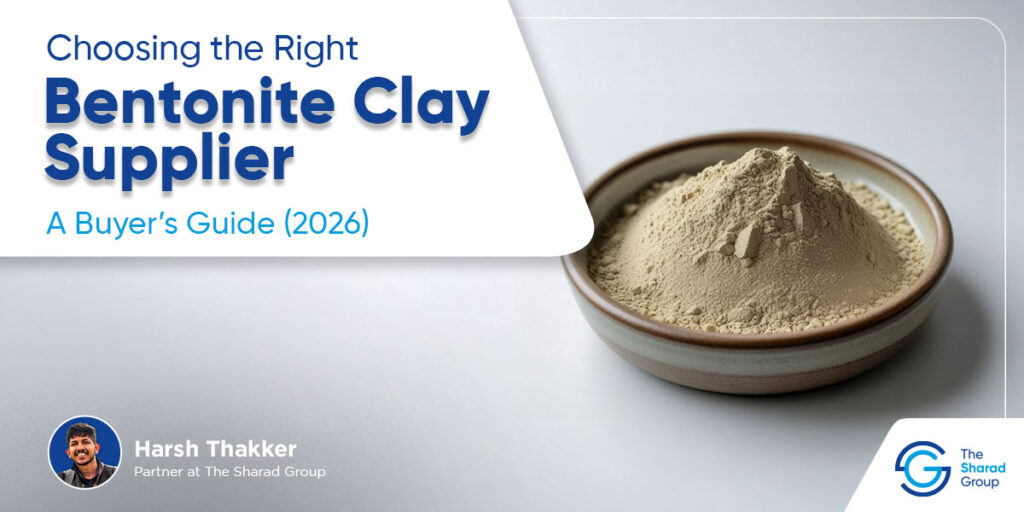
Whether you’re in the construction, energy, manufacturing, pharmaceutical, or personal care industry, I’m not surprised you’re looking for a bentonite clay supplier! The global bentonite clay demand is increasing so much that the market is expected to grow nearly 5 times to over $9.45 billion in less than 10 years.
That’s a doubling every 5 years – nothing short of a revolutionary growth in demand.
So, it’s not just about picking a good one-time supplier of bentonite clay.
Rather, now is the right time to establish a mutually beneficial, long-term relationship with a reliable bentonite clay supplier – one with dedicated mining, refining, testing, and supply chain capabilities.
And in this blog, I’m going to help you choose a supplier that meets all these criteria. You can first check out which bentonite clay supply is right for your business, or jump straight to the part where I’ve discussed the most important factors to consider.
If you’re in a hurry, I’ve also created a small buying guide you can use to evaluate a bentonite clay supplier.
Choosing the Right Bentonite Supplier: Table of Contents
- Choosing the Right Bentonite Supplier: Quick Buying Guide
- Sodium vs. Calcium: Which Bentonite Clay is Right for You?
- How to Choose the Right Clay Manufacturers: Factors to Consider
- The Sharad Group: Your Reliable Bentonite Clay Suppliers
- How to Choose the Right Bentonite Suppliers: FAQs
Choosing the Right Bentonite Supplier: Quick Buying Guide
| Factor of Assessment | Question to Ask | Right Answer to Expect |
| Quality & Certification | “Do you have ISO 9001:2015 and relevant product-grade certifications (e.g., API 13A for drilling)?” | “Yes, we are ISO certified and can provide the specific product-grade certifications you require.” |
| Product & Expertise | “Can you provide both sodium and calcium bentonite, and offer technical guidance for my application?” | “Absolutely. We supply both types and have technical experts to recommend the right grade for your needs.” |
| Supply & Reliability | “What is your production capacity, and can you guarantee on-time delivery for large, recurring orders?” | “We have a high annual output and a robust supply chain to ensure consistent, on-time delivery globally.” |
| Sustainability | “What are your environmental and sustainable mining practices?” | “We follow eco-friendly mining and can detail our sustainable practices and ESG compliance.” |
| Testing & Sampling | “Can I test a sample of the bentonite clay before placing a wholesale order?” | “Yes, we provide free samples and encourage you to verify the quality in your own lab.” |
What's on this page:
ToggleSodium vs. Calcium: Which Bentonite Clay is Right for You?
Choosing the right grade is critical to ensuring that you get all the bentonite clay benefits that your application requires.
So, before we explore the main factors that you should consider while choosing a supplier, let me quickly walk you through the differences between the two main types of bentonite clay.
| Property | Sodium Bentonite | Calcium Bentonite |
| Swelling Capacity | Very High (can swell up to 15-18 times its dry volume when wet) | Low (minimal swelling) |
| Absorption vs. Adsorption | Primarily absorbs water and swells to form a gel. | Primarily adsorbs (draws and holds toxins to its surface). |
| Permeability | Forms a highly impermeable gel layer; excellent for sealing. | Does not form an impermeable barrier. |
| Cation Exchange Capacity (CEC) | High (readily exchanges sodium ions). | Lower than sodium bentonite. |
| Typical Color | Off-white, tan, or grey. | Often white, cream, or yellow. |
Use Cases of the Two Main Types of Bentonite Clay
Based on the key differences mentioned above, here’s a breakdown of the industry applications and use cases of the two bentonite types:
You Need a Sodium Bentonite Supplier For:
- Construction & Civil Engineering: Waterproofing, slurry walls, tunnel boring.
- Drilling Fluids: As a viscosifier in drilling mud.
- Foundry: Binder for sand molds.
- Environmental: Landfill and pond liners.
- Metallurgy: Iron Ore Pelletizing.
You Need a Calcium Bentonite Supplier For:
- Personal Care & Cosmetics: Face masks, skincare, and personal care products.
- Agriculture: Soil conditioner and fertilizer carrier.
- Animal Feed: Binder and detoxifier.
- Wine & Edible Oils: Food-grade, non-toxic clarifying agent.
- Pharmaceuticals: Vital ingredient in some medications.
If you don’t see your industry application listed above, check out my detailed blog on Bentonite Clay vs. Kaolin Clay to find out which type is best suited to your operations.
How to Choose the Right Clay Manufacturers: Factors to Consider
In this section, I’ll walk you through the five most important factors that you must consider to choose the best china clay manufacturer:
Supplier selection becomes much easier when you also understand which grade of sodium bentonite for industrial applications actually fits your process requirements.
1. Quality Assurance and Certifications:
When you’re evaluating bentonite clay suppliers, the first question you should ask is whether their supply meets industry standards.
To answer this question, you can look for two things:
- Relevant certifications like ISO 9001:2015. This will tell you whether a bentonite clay supplier uses quality management systems that are approved by official regulations.
- Second, ensure that the specific grades of the bentonite clay that the supplier offers meet product-grade certifications like API 13A for drilling fluids or good-grade approvals for pharmaceutical and personal care applications.
My suggestion: immediately remove any bentonite clay supplier that doesn’t meet the wider ISO and product-grade certification requirements.
2. Product Range and Technical Expertise
Next, you should ensure that your bentonite supplier has both a versatile product range and the technical expertise to guide your purchase.
All reputed bentonite clay suppliers like The Sharad Group offer different bentonite types, such as calcium bentonite and sodium bentonite.
A very good indicator of a reliable bentonite supplier is that they can create custom bentonite grades tailored to your operations and application.
3. Supply Chain and Reliability
One thing most of my clients ask me in the very first meeting is, “Can you fill large orders?”
While my answer is always an assured, “Absolutely!” backed by years of experience and expertise, if your prospective bentonite supplier can’t answer this question immediately, you might want to ask for their annual output.
Another equally important consideration should be the delivery timeline – a good supply is no good to you if it doesn’t arrive on time for your production cycle.
This is doubly true if your operations have precisely defined production cycles.
For example, our mines and refining facilities are conveniently located in Gujarat with access to smooth marine and road supply chains.
A strategic location near major ports or logistics hubs is even more critical if you’re an export-oriented or overseas buyer: it’ll help you ship supplies globally without any hassle.
4. Sustainability and Sourcing:
One of the most important concerns that has developed recently is sustainability and sourcing.
For example, if you’re operating an enterprise that needs to prove its ESG credentials for funding and investments, you need suppliers that follow environmentally safe mining and refining methods.
So, it’s best to either inquire about your bentonite clay supplier’s sustainable practices or visit their facilities for a first-hand view.
5. Testing and Sampling:
Lastly, when you’re buying bentonite clay wholesale or in small quantities, never place an order without asking for samples!
And once you get the samples, be sure to conduct your own tests to ensure that the bentonite clay’s properties (swelling, viscosity, purity) are suitable for your operations and application.
This is one thing that we at The Sharad Group never compromise on.
We always send our clients samples of the products they’ve requested or invite them for a factory visit so they can be satisfied that we can provide both the quantity and quality of the bentonite clay they’re looking for in the timeframe they’ve specified!
The Sharad Group: Your Reliable Bentonite Clay Suppliers
Through this blog, we’ve explored the two main types of bentonite clay and the 5 most critical factors you should consider when choosing a supplier.
Now, you can confidently evaluate different bentonite clay suppliers by making your own list of requirements and cross-checking them with the factors we’ve discussed.
And since you’re already here, why not make The Sharad Group the first supplier you evaluate? We meet all the requirements we’ve discussed above:
- Quality certifications
- Product range
- Supply chain reliability
- Sustainability
On top of that, we have proven our expertise in supplying quality bentonite clay over the past 30 years by retaining a large number of domestic and international clients.
So, there’s only one step left for you to take in evaluating us as your bentonite clay supplier: tell us about your requirements and request your free bentonite clay samples!
We’ll understand your requirements, ship the samples right away, and even invite you over for an in-person facility visit!
How to Choose the Right Bentonite Suppliers: FAQs
1. What should I look for in bentonite clay manufacturers?
Look for ISO certification, a wide product range, and proven supply chain reliability to ensure consistent quality and on-time delivery.
2. What is the main use of bentonite clay for construction?
Sodium bentonite is vital for construction. Its high swelling capacity creates excellent waterproof seals for foundations and trenches.
3. When do I need sodium bentonite suppliers?
Choose sodium bentonite suppliers for sealing and binding applications, such as construction, drilling mud, and environmental containment barriers.
4. When should I contact calcium bentonite suppliers?
Contact calcium bentonite suppliers for absorption and purification needs, like in cosmetics, agriculture, and food-grade clarifying agents.
5. What should I confirm before a bentonite clay wholesale order?
Always request samples for testing to verify the bentonite clay’s properties, like viscosity and swelling index, match your application.