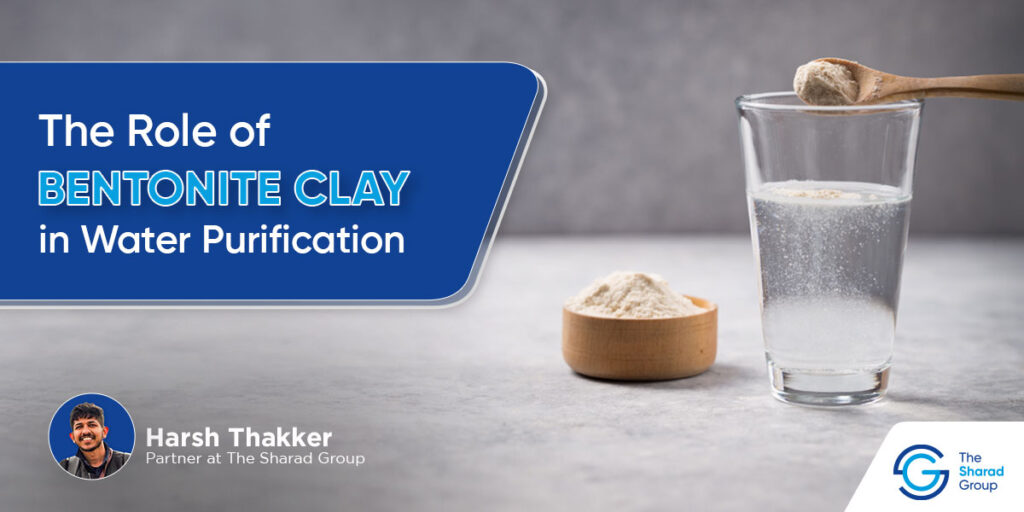
Bentonite clay is an abundantly available natural type of clay.
It’s most commonly found in clay soil deposits, while it is refined to form a white or grey-cream or greenish tan powdery substance.
But what makes water treatment one of its most important and widespread uses of bentonite?
How and why should you use bentonite clay water treatment systems? And where can you find reliable bentonite clay manufacturers for your water treatment applications?
That’s exactly what I’m going to tell you in this blog.
Let’s dive in!
Bentonite Clay in Water Treatment: Table of Contents
- Why is Bentonite Clay Used in Water Treatment?
- How to Use Bentonite Clay in Water Treatment?
- The Benefits of Using Bentonite Clay in Water Treatment
- Bentonite Clay vs Other Flocculants: Table of Comparison
- The Sharad Group: Your Reliable Bentonite Clay Supplier
- Bentonite in Water Treatment: FAQs
Why is Bentonite Clay Used in Water Treatment?
Bentonite clay is a highly absorbent, naturally occurring aluminum phyllosilicate clay.
It is a type of clay that offers a combination of high cation capacity and a negative ionic charge. These properties make water treatment one of the most important applications and uses of bentonite.
Simply put, when you add water to bentonite clay, it will swell several times its original volume, and form a viscous gel that acts as a powerful coagulant + flocculant.
These treatment advantages are part of the wider bentonite clay benefits and uses that make it valuable across environmental and industrial applications.
This allows bentonite in water treatment to efficiently trap and remove suspended solids, heavy metals, and other impurities.
This is why bentonite clay is renowned for its exceptional chemical properties. It’s also a versatile water treatment material that can be used in:
- Industrial wastewater treatment.
- Municipal drinking water plants.
- Residential settings, like ponds.
The only thing you need to worry about is getting your clay from reliable bentonite clay suppliers.
While you don’t need very high-purity bentonite clay for water treatment applications, it’s important that you work with a bentonite clay manufacturer that offers high-quality materials.
Let me show you some of the ways in which you can utilise bentonite clay for water treatment.
How to Use Bentonite Clay in Water Treatment?
Bentonite clay is used to treat water through several established methods. Each of these methods leverages its natural coagulant and sealing properties.
Let’s explore the 5 most common ones:
1. Flocculation and Coagulation
Under this method, bentonite is added to turbid water. Due to its properties, bentonite particles attract suspended contaminants like silt, organic matter, and heavy metals, and form a bond with them.
These form larger, heavier clumps (called “flocs”) that rapidly settle down, leaving clear water above.
2. Landfill and Pond Liners
When bentonite compacts, its swelling capacity creates a low-permeability, self-sealing layer.
This makes it ideal for lining ponds, landfills, and containment areas, where bentonite can effectively prevent groundwater contamination by forming an impermeable barrier that blocks leach growth.
3. Slurry Walls
Constructing bentonite slurry walls is a great way to treat industrial wastewater.
Under this method, a mixture of bentonite and soil (i.e., a slurry) is used to construct vertical barriers in the ground.
These slurry walls then control the flow of contaminated groundwater, directing it toward treatment zones and preventing the spread of pollutants from industrial sites!
4. Geomembrane Protection
Bentonite mats or panels are installed beneath synthetic geomembranes.
They act as a protective cushion and provide a secondary sealing layer.
So, if the primary liner is punctured, the bentonite swells to seal the leak, enhancing the reliability of your containment system.
5. Filter Aid Pre-coat
A thin layer of bentonite clay is sometimes used to pre-coat filter surfaces in treatment plants.
As a result of this, you can prevent the rapid clogging of the primary filter media and improve filtration efficiency due to the porous bentonite cake that can capture finer particles.
The Benefits of Bentonite Clay Water Treatment
Now that we have explored how you can use bentonite in water treatment, let’s quickly explore the benefits you can expect from using it:
- Highly Effective Coagulation: Since bentonite is excellent at binding with suspended particles and heavy metals, it leads to faster settling and clearer water.
- Cost-Efficient: As a naturally available and abundant material, bentonite offers a high-performance, economical alternative to synthetic water treatment chemicals.
- Environmentally Friendly: Since bentonite is a natural clay, it is non-toxic and biodegradable. This makes it one of the most sustainable raw materials for water purification.
- Versatile Application: You can use bentonite clay water treatment systems in treating various water types, from industrial wastewater and municipal supplies to residential ponds and stormwater.
- Reduces Turbidity: Bentonite dramatically improves water clarity by removing fine silt, clay, and colloidal matter very effectively.
- Superior Sealing Capability: Bentonite’s swelling property makes it ideal for creating impermeable liners in ponds and landfills that prevent seepage.
Bentonite Clay vs Other Flocculants: Table of Comparison
To really understand why bentonite clay is a really effective water treatment material, let’s compare it with two other widely used options:
- Aluminum Sulfate (Alum), a common, naturally found inorganic coagulant.
- Polyacrylamide (PAM), a synthetically made organic polymer.
Here’s how Bentonite Clay compares with them for water treatment:
| Parameter | Bentonite Clay | Aluminum Sulfate (Alum) | Polyacrylamide (PAM) |
| Type / Origin | Natural, Clay-Based | Inorganic, Chemical Salt | Synthetic, Polymer |
| Primary Mechanism | Coagulation & Flocculation | Coagulation (Charge Neutralization) | Flocculation (Bridging) |
| Environmental Impact | High (Biodegradable, Non-Toxic) | Low (Lowers pH, Aluminium residue) | Very Low (Potential monomer toxicity) |
| Sludge Volume | High (Adds volume) | Medium | Low (Creates dense flocs) |
| Cost-Effectiveness | High (Low material cost) | Medium | Low (High performance, high cost) |
| Handling & Safety | High (Safe, easy to handle) | Low (Corrosive, requires care) | Medium (Dust control needed) |
| Versatility | High (Clarification & Sealing) | Medium (Primarily for clarification) | High (Wide range of molecular weights) |
| Residual Effects | Inert Clay Minerals | Soluble Aluminium Residuals | Potential Acrylamide Monomer Residuals |
What's on this page:
ToggleAs you can see, bentonite is a natural, organic compound that is as, if not more, effective than its synthetic and inorganic counterparts.
Also Read: Kaolin Clay vs. Bentonite Clay – Which One Should You Use?
The Sharad Group: Your Reliable Bentonite Clay Suppliers
Through this blog, we have discussed why and how bentonite clay is used for treating water.
Its chemical composition and physical properties play a key role in its highly effective water treatment capabilities.
Now, the only question is: where can you get a reliable supply of bentonite clay for your water treatment requirements?
That’s where we come in!
At The Sharad Group, we are one of India’s leading bentonite clay manufacturers.
Over the 30 years that we have been in business, we have amassed a wealth of experience and expertise in mining, refining, and supplying quality bentonite.
So, connect with us, tell us about your project, and we will send you samples + a customised quote that matches your requirements!
Bentonite in Water Treatment: FAQs
1. How does bentonite in water treatment work?
Bentonite swells in water, forming a gel that acts as a coagulant and flocculant. It traps suspended particles and impurities, causing them to clump together and settle out, resulting in clearer water.
2. What are the main uses of bentonite in this industry?
Primary uses of bentonite include clarifying water via flocculation, creating impermeable liners for ponds and landfills, and constructing slurry walls for groundwater control in bentonite clay water treatment.
3. Why choose bentonite over synthetic flocculants?
Bentonite is a natural, cost-effective, and eco-friendly choice. It is non-toxic, biodegradable, and avoids the chemical residuals associated with many synthetic alternatives.
4. Is bentonite clay safe for treating drinking water?
Yes, when used appropriately. Its natural mineral composition and lack of toxicity make it a safe and approved material for clarifying municipal drinking water supplies.
5. Where can I find reliable bentonite clay manufacturers?
As established bentonite clay manufacturers and suppliers, The Sharad Group provides high-purity, expertly processed bentonite clay tailored for diverse water treatment applications.